GHAI’s reflection from the World Health Summit Regional Meeting 2026 in Nairobi
On April 27, 2026, opening day of the World Health Summit Regional Meeting in Nairobi, the Global Health Advocacy Incubator (GHAI) convened a panel under a provocative premise: primary health care (PHC) financing in low- and middle-income countries is not struggling for lack of technical solutions. It is struggling because of weak political ownership, chronic under prioritization in budgets, fragmented accountability and inadequate alignment between universal health coverage commitments and what governments fund. PHC is a political economy challenge before it is a technical one.
That framing shifts the question. Participants in the room were not asked how to design a better PHC system. They were asked who has the political will to finance one and who is doing the advocacy that turns commitment into appropriation.
Allocation, awareness, accountability, advocacy
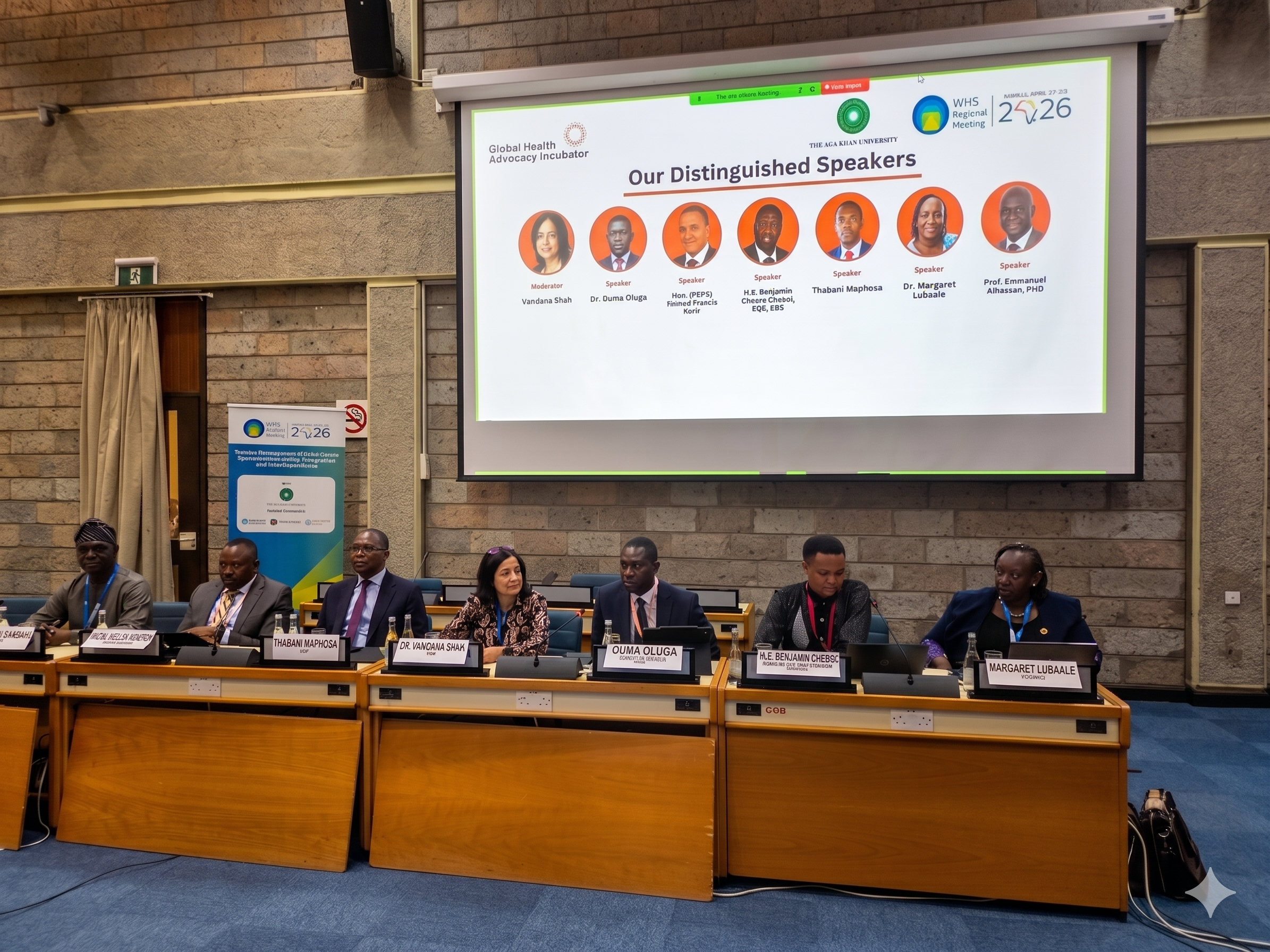
Vandana Shah, GHAI’s Vice President for Health Systems Strengthening, opened and moderated. “It takes many to tango when it comes to sustainable health financing,” she said. Each panelist played the part of the score they were responsible for.
Thabani Maphosa, Chief Country Delivery Officer at Gavi, gave the panel its frame. Parliamentarians, he said, hold three responsibilities: allocation, awareness in a season of misinformation and accountability. Vandana added a fourth “A” from civil society. Advocacy is what creates the political will the other three depend on. Those four words framed the rest of the conversation.
Allocation
Dr. Ouma Oluga, Principal Secretary in Kenya’s State Department for Medical Services, made the case for domestic resource mobilization as a sovereignty issue. Kenya is putting roughly 21 billion Kenya Shillings (about US$162 million) into PHC. “PHC does not work if you make it a business of every individual,” he said. “So, we have made it the business of government.”
Hon. Francis Kuria Kimani, Chair of the Departmental Committee on Finance and National Planning and of the Immunization Caucus of the Parliament of Kenya, held that allocation up to scrutiny. Kenya now spends around 6.5 percent of its national budget on health, a record, but still less than half of the 2001 Abuja Declaration’s 15 percent. “We cannot rely on other people’s resources to immunize our children,” he said. He proposed a single county treasury account so that facilities are not waiting two or three months for releases.
Awareness and accountability
Dr. Oluga returned to the harder question of what happens after money is allocated. Kenya has strong policies and strong legal frameworks. What is missing is implementation and capacity. “The will to implement may exist, but the ability to do may not.” He described facilities that receive PHC funds and spend them in ways that do not move the indicators that matter. “They have not stolen the money. They have just done something very different that is not useful for solving the problem.”
Hon. Felix Maiyo, Deputy Governor of Kenya’s Baringo County, brought the question to the facility level. He argued for domesticating the Facility Improvement Fund, which lets public facilities retain and reinvest the fees they collect. “Sometimes funds [from the Central Government] take more than two or three months to reach a facility, and yet illness does not wait three months.”
But Gavi’s Thabani challenged the counties. “It takes two to tango,” he said. Central governments must release funds on time, but counties must also show how funds already received were spent. He reframed Gavi’s posture in one line. “Our role is to support government in their priorities.”
Advocacy
Dr. Margaret Lubaale, Executive Director of HENNET, made the case for civil society as more than a service delivery actor. “Primary health care cannot do without the voice of the community. We as civil society organizations bring the evidence.” That evidence helped Kenyan civil society sit with the Ministry of Health on sustainable immunization financing and build the case behind the Parliamentary Immunization Caucus. She also widened the frame: “Health is not just a social good. Health is an economic strategy,” she argued.
GHAI’s answer: a budget advocacy model that goes the full cycle
Professor Emmanuel Alhassan, GHAI’s Immunization In-Country Coordinator and Advisor on Noncommunicable Diseases for Nigeria, closed with the model that holds the four A’s—allocation, awareness, accountability and advocacy—together. GHAI’s budget advocacy approach moves through campaign planning anchored in political economy analysis, implementation built on coalition building, accountability for funds already released and sustainability. “If you cannot account for monies that have been released, then why are you going to ask for more money?”
In Nigeria, GHAI’s civil society partners are working with the parliamentary caucus on a bill that would make essential health services and commodities, including immunization, a first-line charge on national revenues. He added that cross-sector advocacy starts before the budget cycle begins, not after the figures are printed.
This is the heart of GHAI’s work. We do not deliver vaccines and we do not run clinics. We build the political will and the accountability infrastructure that decides whether the money moves and whether the next budget cycle protects the gains of the last.
Why this conversation matters now
The political economy frame is not GHAI’s alone. Earlier the same morning, President William Ruto opened the Summit with a blunt accounting. Africa carries more than 25 percent of the global disease burden but accounts for less than three percent of global health expenditure. “Delivering health is first and foremost our responsibility as governments and as Africans. Any other assistance we get is secondary.”
Minding the gap
Thabani offered the take-home image. "How do we mind the gap between being eloquent speakers about financing and getting on with the job?"
That is the gap which GHAI and its partners address every day. The distance between a policy on paper and a release that arrives at a facility on time. The distance between an Abuja commitment and a budget line. To help close these gaps, GHAI provides technical assistance to both civil society organizations and government services that make the decisions on budgeting and programming for PHC services.
Every budget cycle that does not mind the gap is a cycle of children not immunized, clinics not stocked and promises not kept.