In Baringo County, Sheila Chepkoi walks for hours to vaccinate her child. Her story reveals a system catching up to its promises.
Written in collaboration with David Wedeva and Alexander Kieti of HENNET.
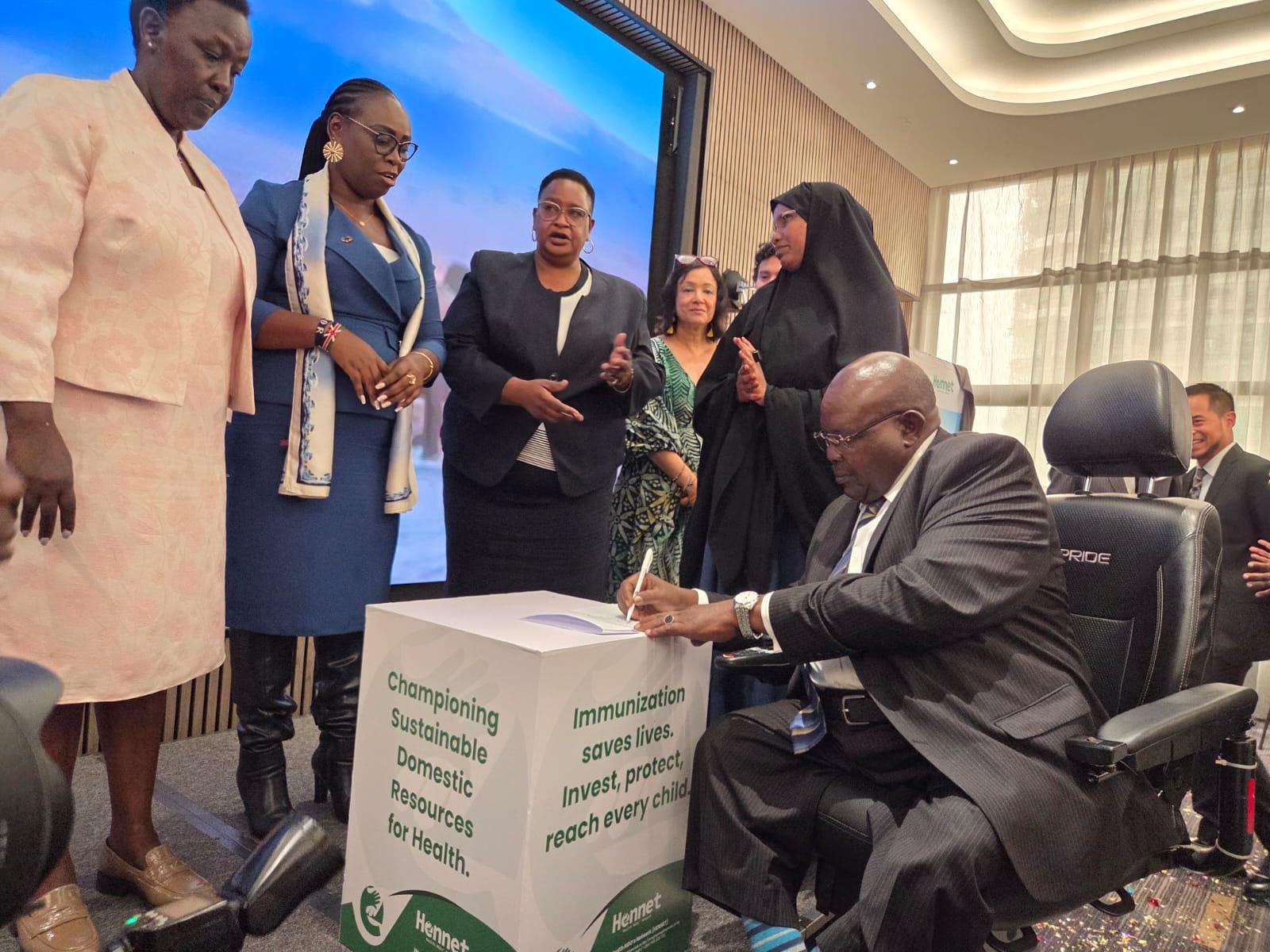
Hon. Dr. Jackson Kosgei, MP for Baringo County and a polio survivor, signs a pledge on behalf of Kenyan MPs at the launch of the Kenya Immunization Parliamentary Caucus, April 29, 2026 — a milestone in the parliamentary push to keep vaccines on the shelf for mothers like Sheila Chepkoi, who walks hours to reach her nearest health facility.
Past Tinamoi and through Mikuu, Sheila Chepkoi walks with her youngest child on her back and worry in her chest. From her home in Baringo County, in Kenya's Rift Valley, the nearest health facility is hours away on foot, and she has no money for transport. She walks because she knows what a missed vaccine can cost her child.
"Our one problem here is that we walk long distances," she says. "We can go all the way to Tinamoi and it was difficult because I didn't have the money."
Faith Ruto, the nurse in charge at Tebei Dispensary, sees mothers like Sheila arrive exhausted and hopeful. She also sees the terrain from the other side of the counter. "The challenges we have here is that some villages are far from the facility. Sometimes the terrain, even the roads, are not good." But distance is only half the battle. When Sheila walks those hours and arrives, vaccines are not always waiting.
When the shelf is empty
Kenya has experienced recurring vaccine stockouts in 2018, 2020, 2024 and 2025. In early 2025, shortages of BCG, polio and rotavirus vaccines hit 12 counties, leaving thousands of children unprotected. The disruptions shook the trust that mothers like Sheila had placed in the system. Why walk for hours if the shelf is bare?
The crisis traced back to a gap in financing. Kenya was still to pay US$12.5 million in co-financing contributions to Gavi, the Vaccine Alliance, which helps lower-income countries procure vaccines at reduced cost. Without payment, supplies stalled.
It was at this point that the Health NGOs Network (HENNET), a Kenyan civil society leader in immunization advocacy, escalated its response. With technical support from the Global Health Advocacy Incubator (GHAI) and funding from Gavi, the Vaccine Alliance, HENNET mobilized parliamentarians, activated media coverage across 12 counties and submitted formal memoranda to the Ministry of Health and the National Assembly's Health Committee. The pressure was strategic, evidence-based and sustained.
Money moved; vaccines followed
In May 2025, the government released US$7 million. Full payment of the full obligation followed. By June 15, vaccines arrived at facilities across the country, ending the crisis. These translated into 1.6 million vaccine doses reaching 890,000 children under five.
Kenya then secured 10 billion Kenya Shillings or KES (about US$76.63 million) for future procurement and increased its national immunization budget allocation from KES 4.6 (about US$35.25 million) billion to KES 7.01 billion (about US$53.72 million).
At the national level, HENNET worked with GHAI to help establish an Immunization Parliamentary Caucus, which was formally launched on April 29, 2026. Lawmakers who bought the idea have already begun demanding structured approaches to financing as Kenya prepares for the transition away from Gavi support. Hon. Bishop Emeritus Dr. Jackson Kipkemoi Kosgei, MP for Baringo County, captured the urgency: "Which way is better: is it an abrupt ending of support, because they have been supporting 70 to 75% of the budget, and we've been funding 25% locally?"
Laikipia County introduced a dedicated immunization budget line for the first time in its 2025/2026 financial year. It was a small allocation, KES 500,000 (about US$3,840), but a significant signal that counties were beginning to own the financing challenge.
Back on the road
For Sheila Chepkoi, policy shifts register not in budget documents but in what she finds at the end of a long walk. A vial on the shelf. A nurse ready to administer. A child protected.
Kenya's immunization story remains unfinished. The terrain in Baringo county is still difficult, the distances still long. But when the government pays for vaccines and immunization program costs on time and counties plan with confidence, mothers who walk for hours find what they came for. That is what partnership between civil society, government and global funders looks like on the ground: a system that meets a mother where she arrives, for the sake of a healthy Kenyan child. GHAI and its partners want to keep supporting these efforts for sustainable, life-saving immunization programs in Kenya.
Past Tinamoi and through Mikuu, Sheila Chepkoi walks with her youngest child on her back and worry in her chest. From her home in Baringo County, in Kenya's Rift Valley, the nearest health facility is hours away on foot, and she has no money for transport. She walks because she knows what a missed vaccine can cost her child.