What do Lunchables[1] and cigarettes have in common? More than most people think. New U.S.-focused research in the American Journal of Public Health (AJPH)’s latest issue argues that some of today’s best-known ultra-processed products (UPPs) were built using the same playbook that made cigarettes so profitable: product engineering, behavioral science and strategies designed to keep people coming back. The takeaway is hard to miss: this is not just a story about food, it’s about corporate power.
Why This Research Hits Home
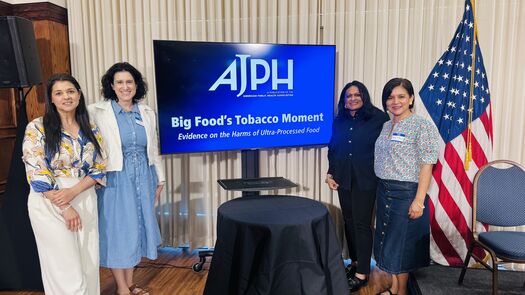
After AJPH’s press briefing to launch the issue, we spoke with Elizabeth Orlan (Associate Director, Research) and Sofía Rincón Gallardo Patiño (Associate Director, Advocacy) from the Global Health Advocacy Incubator (GHAI)’s Food and Nutrition team. Their answers gave the research urgency and shape: Elizabeth spoke from years of work on regulating unhealthy products, while Sofía brought her experience as a nutritionist to ground the conversation in nutrition policy and the daily reality of how hard it can be to eat well in a system built around profit.
Elizabeth put it simply: after spending most of her career on regulation of unhealthy products, it matters to see more evidence published about the harms of UPPs, the links between UPPs and tobacco and the current efforts underway in the United States. Her point is a reminder that this research does not stand alone—it strengthens a case advocates have been building for years.
Sofía explained that as a nutritionist, she watches people’s attempts to eat healthier “fail over and over.” Obesity and noncommunicable diseases are not a failure of individual responsibility; they are “the result of systems shaped by profit.” And while corporate actors have long influenced policy to protect their interests, she argued, documenting and publishing this evidence is essential to driving change. She quoted one of the authors from the series, Dr. Kelly Brownell, saying, changing the food environment when industry profits are at stake can feel like hitting “a brick wall” for policy change—one more reason independent, conflict-free research matters.
The Public Should Understand This Is Not an Accident
If there is one finding the public should understand, Sofía said, it is this: high UPP consumption is “not by chance, coincidence, or any accident.” These products are deliberately engineered—through product design and psychological insight—to drive consumption and override growing health awareness. Minimally processed foods, by contrast, generate less profit, exposing a system tilted toward profit over public health and sustainability.
Elizabeth also emphasized that the public should understand major U.S. tobacco companies have previously owned many UPP companies and built them into the brands they are today, shaping today’s food environment. The Lunchables case is especially telling, she noted, because the product was previously served through the national school lunch program. There was significant innovation from the tobacco side of these companies that informed UPP development—right as these products boomed and expanded internationally.
While this series was largely focused on the U.S.-context, there are implications for global policy too. One paper discussed how U.S.-owned tobacco companies have sold food products worldwide, underlining the need for policy interventions to prevent the growing shift around the world from traditional diets toward UPP-heavy diets, driven by UPP companies flooding markets in Asia, the Middle East and Africa.
What Policymakers Can’t Ignore
For Elizabeth, one piece of evidence policymakers cannot ignore is the level of public support for action. More than 75% of Americans, regardless of political affiliation, understand that UPPs are a major cause of obesity. More than 65% understand that UPPs are addictive. And more than 45% support lawsuits against UPP companies to pay for the health harms caused by their products. She called on U.S. policymakers to see these numbers for what they are and act to pass mandatory, evidence-based policies.
What Tobacco Control Still Teaches Us
The lessons from tobacco control, Sofía said, are not hard to spot. To counter growing health awareness, the UPP industry has mirrored strategies long used by tobacco companies—from larger portion sizes to “light” and reformulated products that keep people consuming rather than moving away. Through fat replacement and reformulation, these products appear to respond to health concerns while still doing the same job: driving consumption.
What gives Sofía hope is momentum. In November 2025, the Lancet published a series on UPPs that presents a comprehensive analysis of UPP production and consumption’s impact on human health, the structural drivers behind their global rise and strategies for reversing this trend. Since the Lancet launch, she said, the momentum on UPPs has only grown, backed by overwhelming evidence of harm. Seeing the evidence of UPPs’ negative health impact coming from countries with high UPP consumption—including the United States—and appearing in journals like AJPH reinforces what the research keeps showing: the harms of UPPs, and the role of corporate behavior in protecting profits, are becoming harder to dismiss.
Why There’s Still Reason for Hope
The fight ahead is clear. GHAI and our civil society partners around the world are pushing for policies grounded in evidence—not corporate manipulation—and for food systems that put health before profit. If tobacco control taught us anything, it’s this: evidence matters, but it doesn’t win on its own. Advocacy does. And on UPPs, the time to act is now.
[1] Lunchables are a U.S. packaged convenience food marketed primarily to children. They include a compartmentalized, ready-to-eat meal kit usually made up of crackers, processed meat, cheese and often a dessert or sweetened beverage. They are widely seen as a quintessential ultra-processed lunch product, and are marketed as the perfect school lunch.