How do governments know which health issues need to be prioritized? A key part of the answer is to rely on comprehensive civil registration data – births, deaths and causes of death - to ensure everyone is counted, making all people visible for effective government planning and policies.
Yet the reality is stark: globally, 40% of deaths go unregistered each year, with no reliable cause of death recorded for half of the deaths that are registered. Moreover, 25% of children under five lack birth registration, leaving them without a legal identity.
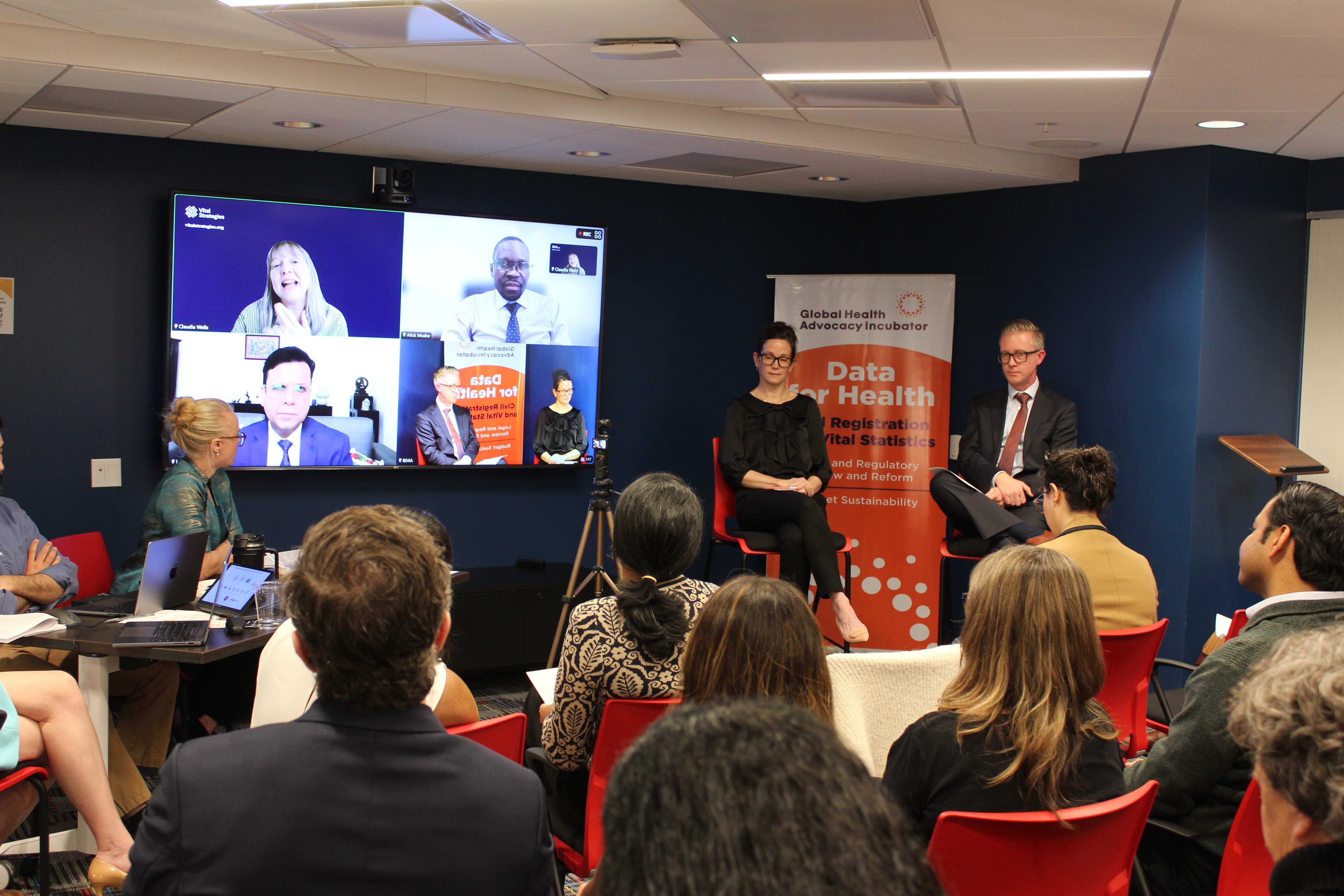
When marginalized populations are left out of the vital statistics generated from civil registration data, governments cannot develop and implement responsive, equitable public health policies, or accurately determine allocation of resources, or priorities in areas such as education and benefits. Recognizing that strong Civil Registration and Vital Statistics (CRVS) systems rely heavily on deliberate policy choices and robust legal frameworks, the Global Health Advocacy Incubator (GHAI) hosted an event on March 4, 2026, titled "Strengthening Civil Registration and Vital Statistics Legal Systems."
During the event, GHAI’s Data for Health team officially launched two new resources: The new CRVS Laws Database and the CRVS Legal E-Learning Course hosted on GHAI's free Health Advocacy Training and Collaboration Hub (HATCH). These tools are designed to demystify complex legal frameworks and make important legal analysis accessible to lawyers and non-lawyers alike.
The launch event brought together global health leaders who underscored the profound human impact of CRVS systems. Vandana Shah, Vice President of Health Systems Strengthening at GHAI, highlighted the foundational nature of this work: "These systems may seem like administrative functions, but they are absolutely fundamental to people’s lives and to effective governance, and strong systems do not emerge by accident but require thoughtful legislative design and sustained coordination.”
Yolonda C. Richardson, President and CEO of the Campaign for Tobacco-Free Kids and GHAI, delivered a keynote stressing “GHAI’s mission is Changing policies to save lives. To change policies, you need to enact laws that make sure everyone is registered, counted in vital statistics and visible for government planning.”
This global initiative is made possible by the Bloomberg Philanthropies Data for Health Initiative. Adrienne Pizatella from Bloomberg Philanthropies’ Public Health team noted in her keynote that many countries operate on outdated or insufficient CRVS laws which fail to provide a comprehensive legal underpinning for modern digital systems. “We really hope these new resources provide inspiration and help strengthen capacity in countries that want to tackle their CRVS laws.”
For nearly a decade, GHAI has worked across more than 30 countries to conduct reviews of countries’ CRVS legal and policy frameworks. Now we are making the resulting analysis and recommendations accessible to the public through:
The Global CRVS Laws Database: Presented by GHAI’s Legal Associate Kriti Sharma, this first-of-its-kind public repository currently benchmarks the legal frameworks of 15 countries against international standards, with more country laws and analysis being actively added over the coming weeks. It features detailed analysis across more than 100 individual legal questions and houses over 250 legal instruments available in English and nine other official languages. The database covers six key topics, including birth and death registration, civil registration system, cause of death certification, stillbirth reporting and vital statistics.
The CRVS Legal E-Learning Course hosted on HATCH: This free, self-paced course was presented by GHAI’s Associate Director of Legal Advocacy Dr. Emelyne Calimoutou. Designed for a wide range of stakeholders—from legal drafters to medical professionals—the course features seven interactive modules. This short video walks through the course and shows it is structured.
To ground these legal resources in practical, country-level realities, GHAI’s Robert Eckford moderated a global panel discussion about how CRVS legal reform matters in practice with Claudia Wells (Managing Director of CRVS, Vital Strategies), Alick Mulao Mushe (Chief Registrar, Technical Services, Department of National Registration, Passport and Citizenship, Zambia), Prof. Pankaj Bhardwaj (Director, the Indian Council of Medical Research ICMR Jodhpur) and Dr. Olga Joos (Managing Director, Medicolegal Death Investigation International Community of Practice, Howard University).
Modern, equitable CRVS systems depend on strong legal frameworks to define responsibilities, remove barriers to registration and protect human rights. By launching these tools, GHAI is taking a step toward a healthier and more equitable future for all.
We invite policymakers, public health professionals and advocates worldwide to utilize these resources to build the case for impactful legal reform. Explore the database and laws today at https://www.crvslaws.org/ and enroll in the free E-Learning course at https://hatchadvocacy.org/.